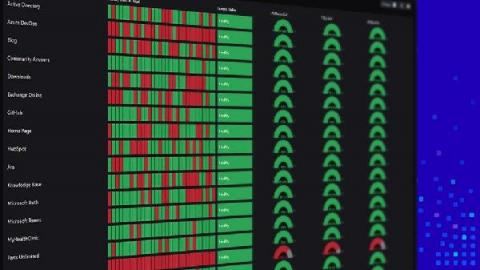
Datadog is an awesome tool for aggregating and visualizing the metrics that matter to you. Recently, Datadog launched a new Incident Management feature, which allows you to coordinate the activities around a problem that affected your service. In this example, I’ll walk through using Relay to roll back a Kubernetes deployment that caused a service impact, and show how the Datadog Incident timeline can keep everyone working on the incident in sync.
An IT self-service portal is much more than an IT storefront. With the consumer-world self-service technology becoming more obvious and available to end-users, it is critical to provide a similar experience with corporate self-service portals. But when it comes to self-service portals, ‘less is more’ doesn’t really work. Who wouldn’t pick a multi-functional portal over the one that is only limited to IT operations?
Mattermost and Jitsi—open source, self-hosted alternatives to Slack and Zoom—now integrate! With the Mattermost Jitsi plugin, Mattermost users can now instantly launch secure Jitsi voice, video and screen-sharing calls, either on-prem with the self-hosted Jitsi software or via the cloud with Jitsi Meet.
Compromising a pod in a Kubernetes cluster can have disastrous consequences on resources in an AWS Elastic Kubernetes Service (EKS) account if access to the Instance Metadata service is not explicitly blocked. The Instance Metadata service is an AWS API listening on a link-local IP address. Only accessible from EC2 instances, it enables the retrieval of metadata that is used to configure or manage an instance.
Digital shopping has exploded over the last few months to levels no one could have planned for. Any kind of performance issue can negatively impact an eCommerce site and cause a drift in loyalty, bounce rates to go up and user conversions to go down. Not to mention how outages or slow page loading impacts employee productivity.
The COVID-19 pandemic has turned our world upside down. Unemployment has soared, entire industries have been impacted, and schools have been shut down. However, one huge change has remained under the radar. We’re on the cusp of witnessing the death of cities as we know them. To understand why let’s rewind to 1870: the start of the industrial revolution in the United States. Industrialization drove people from rural communities to cities.