Operations | Monitoring | ITSM | DevOps | Cloud

The latest News and Information on DevOps, CI/CD, Automation and related technologies.

Intent-driven development: How to guide agents from idea to implementation

Intent-driven development (IDD) is an approach to AI-assisted software development where teams make the desired behavior, constraints, and criteria for success explicit, then give an agent freedom to determine how to achieve the result. As agents take on larger and more autonomous development and maintenance tasks, the implementation itself becomes easier to replace. The important question is whether the software still behaves the way the team intended.

Building Production-ready AI Infrastructure? Start With the Network

AI workloads depend on fast, secure, and scalable access to data across on-premises systems, colocation, cloud platforms, and GPU environments. Here’s how private connectivity can help enterprises move from AI proof of concept to production-ready infrastructure. AI pilots tend to be forgiving. Production isn’t. In the early stages, a team can usually get by with a simple path into a GPU environment, enough bandwidth to test an idea, and a security model that suits a limited group of users.

Why engineers ignore cloud cost governance (and fixes)

Discover why engineers ignore cloud cost governance and how to build developer cost accountability. Learn how Harness helps empower engineering teams. Engineers often overlook cloud costs due to friction in traditional FinOps tools and a lack of real-time visibility. By embedding automated guardrails and shift-left cost insights into developer workflows, organizations can drive accountability without slowing velocity.

Fully Autonomous Software Delivery Demo

See how Harness helps teams move from AI-generated code to production at machine speed. In this demo, Nick Durkin walks through a fully autonomous software delivery workflow inside Harness, showing how teams can review code, enforce policy, run security and LLM scanning, test intelligently, deploy agents, and use Change Advisor to automate approvals with human oversight when needed. You’ll see how Harness helps teams.

What Is GitOps? Principles, Benefits, and How It Works

With GitOps, you can roll back your cluster with git revert and explain each approved change through a commit log. Routing normal changes through Git and running an in-cluster agent that detects drift from the repository gives infrastructure changes the same review and rollback discipline as application code, and Git preserves their history. This guide covers the four GitOps principles, the pull-based reconciliation workflow, and the tools and practices you need to get started.

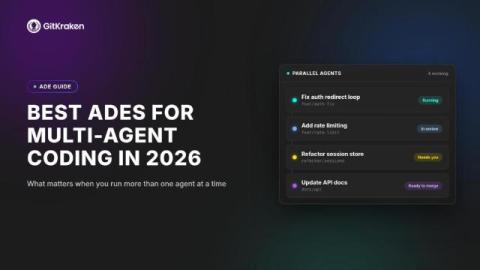
Best ADEs for Multi Agent Coding in 2026

Running one AI coding agent is productive. Running five of them at once across three repositories? That’s a coordination problem. Agentic development environments (ADEs) give you a single surface to orchestrate multiple agents, review what each one changed, and get code merged. Kepler by GitKraken is one of the most capable options in this growing category. It’s built around agent-agnostic orchestration and Git workflow control from backlog to merged PR.

AI Tooling Comes to Cycle - Announcing Cycle's Hosted MCP

TL;DR - We made a way to use Cycle with AI models for doing things like deploying applications faster and diagnosing complex issues. If you'd like to get started right away with Cycle's Hosted MCP, check out our documentation. Today, we're launching a brand new way to interface with the Cycle Platform, that just a year or two ago would have felt entirely like science fiction. Our first ever AI-oriented tooling, Cycle's Hosted MCP, is live today.