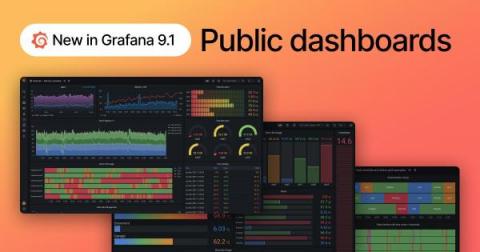
We’re excited to announce the launch of a new feature we’ve been working on in Grafana 9.1: public dashboards 🎉. The public dashboards feature will allow you to share your Grafana dashboard with anyone, even if they’re not part of your Grafana organization. Historically, the only way that someone could share a dashboard externally was taking a one-time snapshot 📸, or disabling all authorization for their Grafana instance 😬.
DX NetOps 22.2 optimizes network operations with industry-leading visibility, scale and modern network coverage beyond the network edge to quickly and easily isolate end-user experience impact of network performance issues. Recent research revealed that 67% of companies cite internet and cloud network paths as monitoring blind spots. Furthermore, 71% of companies say that adoption of new network technologies is delayed by inadequate network monitoring software.
Among the 200+ fully features services that Amazon Web Services (AWS) offers, Elastic Compute Cloud (EC2) is the most popular. In the recent eG Innovations and DevOps Institute survey of 900+ IT professionals, cloud instances were the most commonly used cloud service, with 63% usage among respondents.
This article was originally published in The New Stack and is reposted here with permission. You may be familiar with live examples of machine learning (ML) and deep learning (DL) technologies, like face recognition, optical character recognition OCR, the Python language translator, and natural language search (NLS). But now, DL and ML are working toward predicting things like the stock market, weather and credit fraud with astounding accuracy.
This article was written by Shane from Infosys. Infosys is a global IT Leader, headquartered in India, with over 200,000 employees and a focus on digital transformation, AI/ML, and Analytics. Our organization faces challenges when working with data to assist with proactive anomaly detection, triaging incidents to accommodate for data and volume growth, and maintaining high availability and SLA’s for a near 100% uptime.
The definition of operational excellence is undergoing profound change. Instead of an enterprise consisting of multiple islands of expertise and efficiency, operational excellence now means breaking down the operational barriers to improve collaboration across departmental lines. This more holistic approach unites the complementary expertise of different teams to create a whole that’s greater than the sum of its parts.
In our RESOLVE ’22 event The SOC and the NOC, moderator and 3 Tree Tech VP of Cybersecurity Kris Taylor welcomed two esteemed guests to the stage: As Kris noted at the top of the event, we brought our panelists together to talk about “the culture of the network operating center (NOC) and security operations center (SOC).” Along the way, they discussed different philosophical and practical takes on the high-level topics of networking and security.
In today’s digital world, organizations are constantly undergoing change. They’re moving to the cloud and rolling out DevOps at scale—all in the name of driving innovation. But moving from a monolith to microservices can lead to applications becoming increasingly distributed. When problems arise, customers don’t care how many teams and services you have, or how complex your architecture is. They only care that your services work when they need them to.
If you asked your engineering team how well they can handle all of the security and observability data they’re managing, would you get a resounding “Yeah boss, we’re good to go!” in response? Possible, but unlikely. Chances are they feel like they’re stuck on a boat that’s taking on water, spending their day using tiny buckets to scoop some of it out, with no way to plug any of the leaks.