Operations | Monitoring | ITSM | DevOps | Cloud

The latest News and Information on Monitoring for Websites, Applications, APIs, Infrastructure, and other technologies.

How to manage log files using logrotate

Logs are records of system events and activities that provide valuable information used to support a wide range of administrative tasks—from analyzing application performance and debugging system errors to investigating security and compliance issues. Large-scale production environments emit enormous quantities of logs, which can make them more challenging to manage and introduces the risk of losing important data if underlying resources run out of space.
Get to Know WhatsUp Gold Free Edition

We sympathize with the IT teams that keep their networks running – we really do. We understand it’s a thankless job where they’re ignored if everything’s working and blamed when everything’s not. That’s why we’ve tried to make our network infrastructure and application experience (AX) products as simple and intuitive as possible.

Why You Should Monitor Your E-Commerce and How to Start

According to research by the SolarWinds® Pingdom® team, retail and e-commerce sites have plenty of room for improvement, as the global market generated revenues up to US$4.921 trillion in 2021. As more people look to the internet to make purchasing more convenient, online sales will become even more critical to businesses. What does this mean if you’re a seller?

Ask Miss O11y: Making Sense of OpenTelemetry: Who's There? The Resource.

Ah, I too have wondered about this. TL;DR: The Resource says what program is sending these spans and where it’s running. You can skip it if you define OTEL_SERVICE_NAME in the environment. When I’m setting up tracing (for instance, in a Node.js app), I have to create a Resource object in order to set up the OpenTelemetry SDK: If I don’t define that resource parameter, then tracing will still work. But my spans will show up with aservice.name of unknown_service:node.

Azure DevOps: Fun with Observability Events and Alerts!

If you’re working with microservices in a large distributed environment, you’ve probably got your monitoring and logging on lock, and you may even be lucky enough to have properly instrumented APM (distributed tracing) for consumer calls. But, did you know you’re likely still facing an observability gap? How many incidents have you worked that required hours of sleuthing only to end with a single team needing to roll back a deployment? It’s more common than you may think!

Dashboard Fridays: Log Analytics VM Insights

Join Adam Kinniburgh in this latest Dashboard Fridays episode, in which he showcases a Log Analytics VM Insights dashboard. This dashboard, built with the WebAPI tile for the CE and SCOM editions of SquaredUp, surfaces key metric data for Virtual Machines, regardless of where the servers are hosted. In this short video, we'll demonstrate how this dashboard was built using SquaredUp dashboards, the challenges it solves, and how you can easily replicate it in your own environment.

What is a Good API Response Time?

It's hard to imagine a world without APIs. APIs connect our mobile phones or computers to do everything from making purchases and payments to interacting on social media, extracting or sharing data or any other computer to computer interaction in our business or daily life. If you want to open up a heated debate, ask one of your programming partners or developer colleagues what makes up a good API response time?

Sponsored Post

The Dirty Data Problem: Why Modernizing Infrastructure Monitoring is Pivotal to AIOps Success

Jeff Dean at Google Brain once said that the most sophisticated AI algorithms succumb to the quality of the dataset they rely on. That's a fancy way of saying: "Garbage in, garbage out." And if your organization is struggling with the effects of dirty data-inaccurate analytics, sub-optimal automations, and persistent problems with IT operations management-chances are you've got visibility gaps in your infrastructure that have you operating with a CMDB filled with inaccurate, incomplete, or obsolete information.

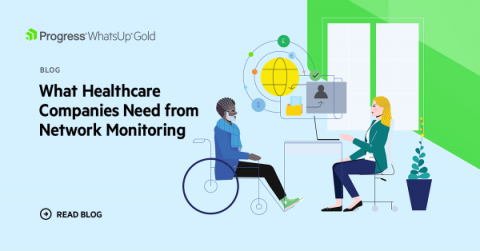
What Healthcare Companies Need from Network Management and Network Monitoring

IT pros in the healthcare industry have one of the toughest jobs imaginable. Herculean task number one is protecting patient data, with failure to do so bringing hefty HIPAA fines and more than a little bad press. Gargantuan task number two is stopping breaches (and then doing forensics if one busts through). Failing either of these is not exactly a confidence booster. Don’t forget, almost all hacks and breaches either attack the network itself or go across it to reach their target.