Technologies exist to limit and spot the number of phishing emails that come into your business. Still, humans are the last line of defense against social engineering attacks like this at the end of the day. At some point, you're going to "be beat" as an employer or MSP. Instead of locking everything down and slowing business communications, staff from the c-suite on down need to be equipped to identify phishing emails, so the worst happens in a training environment and not the real thing.
On the heels of launching our new open source TSDB Grafana Mimir, we are excited to introduce Grafana Enterprise Metrics 2.0. GEM 2.0 is built on top of Grafana Mimir 2.0, our easy-to-operate, high-scale database which we’ve shown can handle upwards of 1 billion active series. That means that GEM 2.0 inherits all of the highlights of Mimir, including easy deployment, native multi-tenancy, high availability, durable long-term metrics storage, and exceptional query performance.
A NoSQL database provides a mechanism for data storage and retrieval, without using the tabular relations associated with relational databases. Originally referred to as "non-SQL" or "non-relational" databases, NoSQL databases are increasingly used in big data and real-time web application environments. NoSQL systems are also sometimes called “Not only SQL” to emphasize that they may support SQL-like query languages or sit alongside SQL databases in polyglot-persistent architectures.
Good security may come from strong defenses, but strong security comes from a good offense. This is especially true for network security, where minutes can make the difference between a breach and a near miss. For example, if an unknown IP address triggers an alert for suspicious or abusive behavior, the faster you can isolate and block that address, the less likely it is that the person or entity at the other end can do damage.
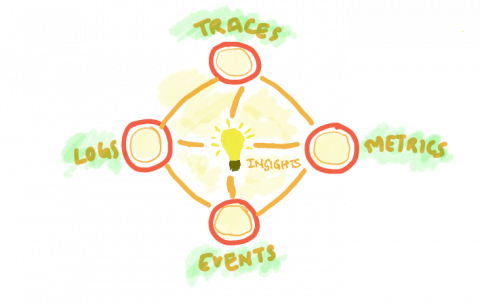
Losing track of communication between applications or code has become a problem with the tech world growing more into supporting Serverless cloud architectures and allowing the developer to maintain, upgrade and update these services. One might say that services and code are becoming more loosely coupled, allowing code to run and execute in silos. Let's take an AWS Lambda function as an example.