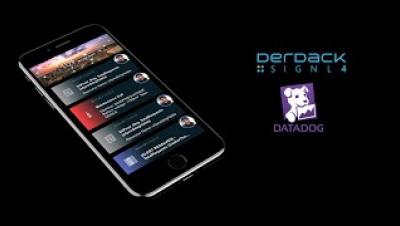
How to Use SIGNL4 to enhance your Datadog alerting and ticket response
SIGNL4 and Datadog integration steps and how SIGNL4 complements Datadog with anywhere, mobile ticket alerting and response and adds on-call management


The latest News and Information on Incident Management, On-Call, Incident Response and related technologies.
Summer has passed and it’s time for fall - cue transitioning leaves, cozy blankets, and all the pumpkin-themed things your heart could ever desire. As we move into the new season, we are excited to announce our fall product releases across Moogsoft Cloud that enable engineers to detect incidents earlier, resolve them faster, and work as a team across the entire lifecycle. Moogsoft’s Fall product updates enable you to: … and so much more! Read on for deeper details.
Event correlation and AIOps go hand-in-hand. Event correlation is the process of identifying patterns in data that may indicate a problem or opportunity.
As organizations grow and become more complex, so does the need to monitor and troubleshoot issues across the entire IT infrastructure. Event correlation is a powerful technique that can help make sense of the huge volume of alert data generated by monitoring systems and identify problems as they occur. In this blog, we’ll look at event types, use cases for event correlation and approaches that organizations can use to get the most out of this valuable tool.
More than 16 months ago we provided a solution to integrate HashiCorp Consul with our alerting and on-call management platform by using consul-alerts - a dedicated application that allows for communication between a deployed Consul instance and an existing iLert account. With more code infrastructure being moved to the cloud to ensure better security and availability, we too have ensured that our service integrates with the HashiCorp Cloud Platform (HCP).
Like most tech companies, we use an on-call rota and various alerting tools. We do this to respond to incidents before they’re reported. Proactively identifying issues and communicating to customers helps us provide great experiences and fosters trust. Internally, we’ve been using these alerting tools in tandem with our auto-create incidents feature. We’ve found that it’s made responding to the pager much smoother - it’s one less thing to do when you get paged at 2am.
Today I am excited to announce we have officially shipped PagerTree 4.0! Here are the highlights: This effort has been a year and half in development and I sincerely want to thank each and every one of our customers for the constructive feedback, ideas, and countless hours on Zoom calls. Without you this journey wouldn’t be possible. We are excited to get this major release shipped, just in time for the holidays. You can check out the full details of the upgrade below.
So you’ve decided to take advantage of Site Reliability Engineering by hiring SREs for your company. Now, you have a second decision to make: Exactly how many SREs to hire. Do you need just one or two SREs? Or should you build a sprawling SRE team, with a dozen or more SREs on hand to support your organization’s reliability needs? The answers to these questions will, of course, vary; every business’s needs are different.