Our stack for acquiring and retaining customers
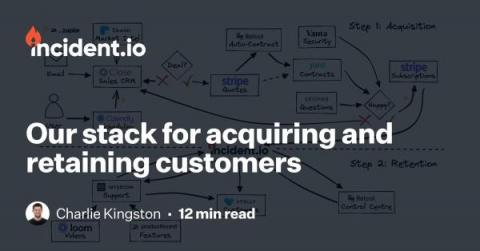
We’ve been building incident.io for 12 months and thought it would be a good time to share the constellation of tools that we’re using to power our customer experience.


The latest News and Information on Incident Management, On-Call, Incident Response and related technologies.
We’ve been building incident.io for 12 months and thought it would be a good time to share the constellation of tools that we’re using to power our customer experience.
Over the past few years, artificial intelligence for IT Operations (AIOps) has risen in popularity within the technology landscape. It’s become a buzzword in the marketing world, and while there are many ways to define AIOps, the best way to start thinking about it is through the lens of outcomes, correlation and strategy—it’s all about the data.
When critical incidents happen — which they inevitably do 😅 — and you’re in the middle of trying to figure out what the best thing to do is, it can feel comforting to know that you’ve got a pre-prepared list of instructions to follow, commonly known as an “incident response plan”: In theory this sounds quite simple, and a typical flow you might envision is: It might be tempting to think that the hardest part of running incidents is finding or writing a checkl
Engineers have been managing incidents for as long as they’ve been building software, but the idea of incident management as a strategic practice in its own right is still finding its place. We’re starting to see big shifts in that area, though — more companies are dedicating headcount, resources, and tools to help them better prepare for, respond to, and learn from their incidents.
What are the keys to building software development security into the early stages of product development? And what are the costs of ignoring security? In this article, xMatters Product Manager Kit Brown-Watts provides his insights on the matter. Every investment decision comes with trade-offs, usually in the form of cost, quality, or speed. The CQS Matrix, as I like to call it, captures the dilemma most product people face.