Operations | Monitoring | ITSM | DevOps | Cloud

What is expected in the SRE role? We analyzed 30 job postings to find out.

In 2016, Google released the definitive book on Site Reliability Engineering (SRE) - a practice that had originated in the company to take care of a monumental problem - how to keep the Google services running with high reliability. Over the years, SRE has been widely adopted by dev teams across the globe and is a popular role at startups and enterprises alike. Here is a look at how search for SRE has trended over the years.

The Complete List of Spring Boot Annotations You Must Know

Spring Boot is the most popular Java framework, with over 50 percent of developers using it. Java engineers working in the spring framework can deploy web applications quickly, without the need for a separate server. Spring focuses on speed, simplicity, and productivity. It uses Inversion of Control, or IoC, and dependency injection to increase modularity and enable loose coupling. Spring Boot builds off of the spring framework.

GitKraken v8: CLI Preview & Deep Linking

At GitKraken, we know every developer wants to focus on delivering the best projects. Spending time and energy switching between tools, or struggling to keep focus when digging through code, are things we would all love to minimize. This is precisely what has driven us to introduce the unbelievable new set of features in the GitKraken v8.0 release! Download the most powerful version of GitKraken ever, for free! Download GitKraken Windows / Mac / Linux.

GitKraken Acquires BigBrassBand, Creator of Git Integration for Jira

As part of GitKraken’s ongoing mission to make software developers and Agile DevOps teams more productive using Git, we are excited to announce today that we are bringing another Git collaboration tool into the Kraken family: Git Integration for Jira by BigBrassBand. With over 3.6 million users in 10,000 companies, Git Integration for Jira is the most popular paid Atlassian Marketplace app for integrating Git and Jira DevOps workflows.

Datadog vs. Grafana: Compare Use Cases and Features

The current big data world allows even tiny IT environments to produce massive amounts of information. After determining how to open up various data generation sources, a business analyzes the information. Here, the analysis method you leverage varies depending on the data, the tools/equipment used, and the use case. A good practice is to visualize the traces, weather logs, data, or metrics.

Creating your first module using Terraform

Deploying infrastructure manually is an outdated practice. Using Terraform to automate manual deployment is the new normal. In this blog, we have explained in detail, how to create your first module using Terraform. Before the advent of cloud and DevOps, most companies managed and deployed their infrastructure manually. This used to be risky because not only was it error-prone, it also slowed down the entire infrastructure cycle.

Top 10 Questions About Uptime Monitoring

Monitoring for uptime is becoming increasingly necessary as SaaS and Always-On services integrate deeper with our professional and personal lives. When bottom lines and infrastructure requirements are tied so closely to 24/7 accessibility, making sure your websites are UP becomes priority one. We’ve scoured our support tickets, talked to our users, and kept an ear to the ground to compile the top 10 questions surrounding uptime monitoring and break down the answers.

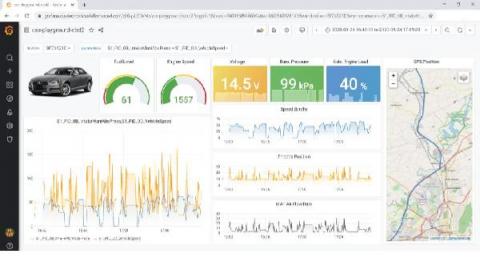
With Grafana and InfluxDB, CSS Electronics visualizes CAN IoT data to monitor vehicles and machinery

Martin Falch, co-owner and head of sales and marketing at CSS Electronics, is an expert on “CAN bus” data. Martin works closely with end users, typically OEM engineers, across diverse industries (automotive, heavy-duty, maritime, industrial). He is passionate about open source software and has been spearheading the integration of the CANedge with InfluxDB databases and Grafana telematics dashboards.

Podcast: Break Things on Purpose | John Martinez, Director of Cloud R&D at Palo Alto Networks

In this episode Jason is joined by John Martinez, Director of Cloud R&D at Palo Alto Networks, to talk about the FinOps Foundation and the vast range of optimization opportunities to reduce spend in the cloud. John comes in with some extremely useful insights into how FinOps is laid out and their use of a “crawl, walk, run approach.” John and Jason discuss multi cloud and go into the specifics on the costs associated with multi cloud as well the security changes that will come with.