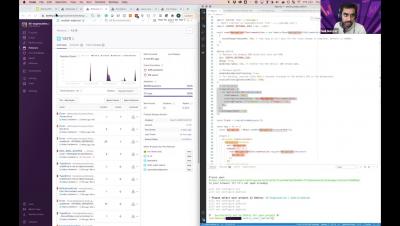
Application Monitoring 101: How to Setup and Monitor Performance in Android Applications
Neil Manvar (Solutions Engineer @Sentry) shows how to setup and monitoring Performance in your Android applications.


The latest News and Information on Monitoring for Websites, Applications, APIs, Infrastructure, and other technologies.
SaaS or Software-as-a-Service make up a growing amount of business-critical functionality. Gone are the days of hosting every single application necessary to run a successful business. Everything from email hosting, financial systems, and human resources functions are all now done on SaaS-hosted platforms. The knowledge that all of this is out of your hands is both freeing and frustrating.
When internal IT teams are responsible for ensuring service uptime, it becomes a challenge with cloud applications like Teams – especially when you don’t know the root cause of an outage. The reality for most organizations relying on Microsoft Teams and other Office 365 cloud services is that there’s an innate expectation that service availability is going to be met; Microsoft has enough redundant infrastructure to ensure they can meet their 99.9% service level agreement.
Microsoft released its desktop-as-a-service (DaaS) offering, WVD (Windows Virtual Desktop), to the general public in September 2019. The service runs on Azure and provides a multi-user version of Windows 10, a feature unavailable for on-premises deployments of Hyper-V. WVD is a free service for Microsoft customers with most types of Windows 10 Enterprise license, however, the subscription or PAYG Azure costs are additional, as are many components you may wish to add.
One of the focuses of version 2.9 of Icinga Web 2 will be on access control. For years on now, Icinga Web 2 had a very simple role based access control (RBAC) implementation. This suited most of our users fine. However, there were still some requests to enhance this further. The next major update of Icinga Web 2 (Version 2.9) and Icinga DB Web will allow users to configure exactly this.
Link analysis, which is a data analysis approach used to discover relationships and connections between data elements and entities, has many use cases including cybersecurity, fraud analytics, crime investigations, and finance. In my last post, "Advanced Link Analysis: Part 1 - Solving the Challenge of Information Density," I covered how advanced link analysis can be used to solve the challenge of information density.