Operations | Monitoring | ITSM | DevOps | Cloud

OpenTelemetry Gotchas: Phantom Spans

This guest post is written by Ian Duncan, Staff Engineer - Stability Team at Mercury. To view the original post, go to Ian's website. At work, we use OpenTelemetry extensively to trace execution of our Haskell codebase. We struggled for several months with a mysterious tracing issue in our production environment wherein unrelated web requests were being linked together in the same trace, but we could never see the root trace span.


Custom domains now available on preview environments

You’re probably all very familiar with the URLs we currently generate automatically for your environments on Upsun by now. And while they are very useful, they’re not the most friendly-looking as, we build them using the following pattern: This approach is important because it ensures that our URLs are unique for all projects and their environments but it also makes them pretty long, overly complicated, and let’s face it—not the prettiest. But this is the case no more!

How improved network performance is a key part of Web 3.0 delivery

Web 3.0 could see the emergence of more decentralized online ecosystem based on blockchain. In this blog, we examine the important role that network performance will play in the arrival of Web3 in order to reduce frustrations and shortcomings with the existing traditional public internet. In this blog we look at the role network performance will play in the delivery of web 3.0.

Microsoft OneDrive: Your Ultimate Guide to Cloud Storage

Hey there, cloud wanderer! Ever found yourself juggling multiple USB drives or emailing files to yourself just to have access to them on another device? Well, Microsoft OneDrive is here to make your life a whole lot easier. This article will be your ultimate guide to understanding what OneDrive is, how to use it, and why it might just be the cloud storage solution you’ve been looking for.

Bringing speedups to top-k queries with many and/or high-frequency terms

Disjunctive queries (term_1 OR term_2 OR... OR term_n) are extremely commonly used, thus they are getting a lot of attention when it comes to improving query evaluation efficiency. Apache Lucene has two main optimizations for evaluating disjunctive queries: BS1 on the one hand for exhaustive evaluation, and MAXSCORE and WAND on the other hand to compute top hits.

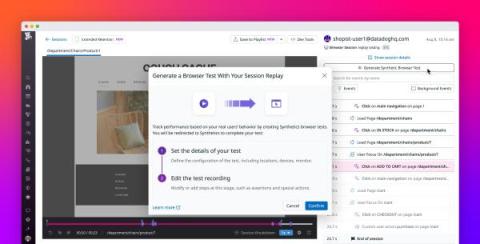
Create browser tests directly from Datadog RUM Session Replay

Testing is a key part of application development and helps you maintain a reliable experience for your users. But the process can be difficult to scale and is often siloed to a single team or individual that does not have broad knowledge of your application’s UI. This can lead to organizations investing in sizable test suites that do not accurately represent real user behavior.

How to Improve Core Web Vitals

Gaps in website performance optimization have a devastating effect, and you will surely get strict penalties for making them happen. Websites failing to pass the Google Core Web Vitals assessment can expect their traffic, conversions, and business revenue to go south. And they can only make up the leeway with fast intervention and ingenious strategic planning.

Day 1 Navigate Europe 2023 Wrap Up

Navigate Europe 2023 has come to an end, and we couldn’t be more grateful for everyone involved in this, from our sponsors, attendees, and most importantly, the Civo team. Whilst we have already announced the next event for next year in Austin, Texas, we want to spend some time reflecting on the amazing few days we’ve just had, and everything we took away from it.

How to provision a notification policy in Grafana Alerting - and keep it editable in the UI

Provisioning Grafana Alerting resources, such as notification policies, can help you deploy resources faster and streamline the alerting and notification process. Before getting started, it’s important to understand the different options for provisioning notification policies, how they work, and the challenges they can present. In Grafana Alerting, notification policies use alert labels to determine how alerts are routed to different contact points or receivers.