Operations | Monitoring | ITSM | DevOps | Cloud

How to Detect Memory Leaks in Java: Causes, Types, & Tools

A memory leak is a situation where unused objects occupy unnecessary space in memory. Unused objects are typically removed by the Java Garbage Collector (GC) but in cases where objects are still being referenced, they are not eligible to be removed. As a result, these unused objects are unnecessarily maintained in memory. Memory leaks block access to resources and cause an application to consume more memory over time, leading to degrading system performance.

Consolidate Knowledge Base Articles from Multiple Departments in 5 Steps

After adopting foundational practices of knowledge management many organizations aim to expand this practice outside of IT. While comprehensive knowledge management is an effective way to connect employees to solutions from multiple departments, maintenance can be a major challenge. This post will dive a little deeper into how to consolidate knowledge base articles from multiple departments.

Why We're Embracing Password 3.0...And You Should Too

Password 1.0 was your cat’s name and your birth year and you used it across every endpoint for a decade. We see you, Sprinkles1979. Password 2.0 was SSO and MFA and WTF because literally everyone used Facebook for authentication. We all saw how well that went. It’s time for Password 3.0 We’ve always operated at the leading edge of innovation, and this is no exception. While the industry gets bogged down in sending texts to confirm authorization, we’re moving forward.

Resolve Network and VPN Performance Problems Faster with Endpoint Monitoring

IT professionals are now adapting to remote environments and learning to manage a distributed, homebound workforce. In recent conversations with IT pros, many have cited that connectivity/VPN and home network issues are their top challenges but they lack the visibility to diagnose and troubleshoot these problems. Catchpoint for employee experience monitoring gives IT teams what they need: visibility from remote users’ devices to any business-critical application across any network.

Introducing Stackoscope For Serverless Applications

Here at Lumigo, we are focused on helping customers succeed with serverless and make it easier for them to build and run serverless applications in production. We love serverless and operate one of the largest serverless systems out there as we ingest and process billions of events from our customers. One thing many customers have asked us for help with is to identify misconfigured resources or places where they can improve by following best practices.

One Year of Graviton2 at Honeycomb

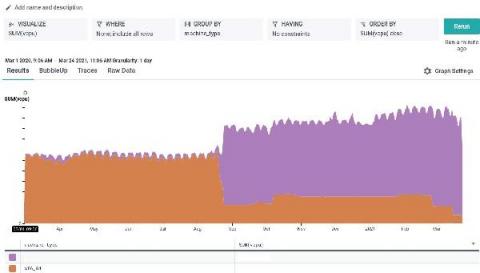
A year ago, we wrote about our experiences as early adopters of Graviton2, and how we were able to see 30% price-performance improvements on one dogfood workload from switching to the arm64 architecture. In those initial experiments, we validated running 20% fewer shepherd ingest workers, using the m6g instance type, which cost 10% less per instance compared to c5 instances.

Time-based scaling of Enterprise Search on Elastic Cloud

Does your Elastic Enterprise Search Cloud deployment follow a predictable usage pattern? You can automatically scale up and down your deployment on a schedule to achieve optimal performance and reduce operating costs. In this article we show you how to use the Elastic Cloud API to change how many Enterprise Search nodes you’re running. We call these APIs from a cron job to achieve hands-free, time-triggered autoscaling.

Discover in Kibana uses the fields API in 7.12

With Elastic 7.12, Discover now uses the fields API by default. Reading from _source is still supported through a switch in the Advanced Settings. This change stems from updates made to Elasticsearch in 7.11 with the extension of the Search API to include the new fields parameter. When using the new search parameter, both a document’s raw source and the index mappings to load and return values are used.