Cycle Podcast | Episode 1 "The Intro"
Get to know the Cycle crew as they discuss what is being worked on for the week. Conversations include the development team moving towards marketing, building a marketing API, Changelogs, and more.


The latest News and Information on DevOps, CI/CD, Automation and related technologies.
Speedscale was built primarily to provide engineering teams with better insight into their applications over time, replaying single transactions for root cause analysis that give developers and SREs confidence that tomorrow’s application code will work just as well in production as it did yesterday.
Observability, which originated from control theory, measures how well you can understand a system’s internal states from its external outputs. Observability uses instrumentation to provide insights that aid monitoring. In DevOps, gaining observability is achieved through a set of monitoring solutions. The shift to use one vendor platform to do so, versus multiple solutions, make sense as.
Congratulations, you finally consider moving your apps to Kubernetes. It is a big day! Here is a checklist to ensure you did not forget anything essential to increase your chances of success using Kubernetes. We divided those points into three sections, from the most important to the least. Let’s go.
In today’s data-centric world, metrics or numbers define all performance benchmarks. The time between when an event starts and ends shows how well a system can handle and process such events. One of such metrics is MTTR. MTTR usually stands for Mean Time To Resolution, but it has held several meanings over the years. MTTR is a metric used to measure how well a system can bounce back from errors and provide long-lasting solutions.
We are proud to announce that CircleCI has acquired Vamp, the first cloud-native release orchestration platform. This paves the way for CircleCI customers to have first-class release orchestration and continuous validation, all natively within the CircleCI platform.
Today we announced our Series F round of $100M led by Greenspring Associates, with Eleven Prime, IVP, Sapphire Ventures, Top Tier Capital Partners, Baseline Ventures, Threshold, Scale, Owl Rock, and Next Equity Partners. Thank you to our customers, community, partners, investors, and team. This latest investment allows us to invest as well; in our product, our community, and in our people. We build for the builders of the digital age: developers.
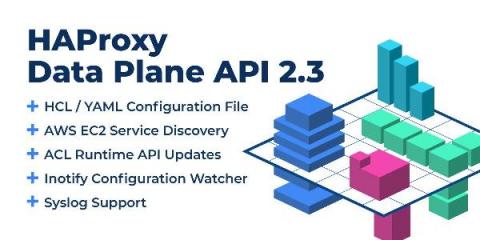
The HAProxy Data Plane API 2.3 expands its service discovery mechanisms and introduces native support for discovering AWS EC2 instances and auto-scaling groups. It also adds a new configuration file that supports HCL and YAML, an Inotify configuration watcher, and Syslog support. HAProxy Data Plane API version 2.3 is now available and you will find it in the 2.3 version of the Alpine Docker image.