


Operations | Monitoring | ITSM | DevOps | Cloud

The quiet problem underneath modern software delivery: database change at scale

Application delivery has accelerated over the last decade. Modern CI/CD pipelines, automated testing, and cloud infrastructure have already raised the baseline. Now AI-assisted coding tools are compressing timelines further still - developers are writing and shipping code faster than ever.

(AusBiz) JFrog teams up with Nvidia to manage AI agents

AI agents are making real-time decisions inside enterprises right now; pulling code, accessing tools, executing tasks. But most businesses have zero visibility into what those agents are actually using. In this interview on @ausbizTV, Sunny Rao, SVP APAC at JFrog, explains why the governance gap is one of the biggest risks facing enterprises today; and how JFrog and NVIDIA are building the trust layer to fix it.

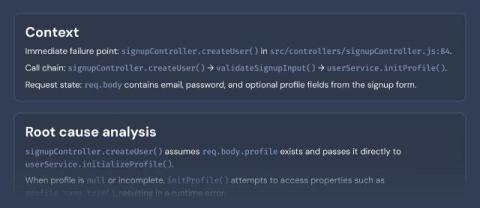
From Stack Trace to Probable Cause: AI Root Cause Analysis Is Here

You know the drill. An error fires, you get the stack trace, and then you spend the next 45 minutes tracing it backward through four services, two config files, and a deploy that happened three hours ago. You eventually find the root cause, but the path to get there was manual, slow, and entirely dependent on how well you already knew the codebase. We built AI-powered root cause analysis (RCA) for that kind of slog.

Getting more out of Playwright CLI: a practical guide for QA and DevOps teams

If your team runs Playwright tests in CI, you already know the npx playwright test drill. It works fine until your suite crosses a few hundred tests. Then things get messy. Flaky reruns stack up. Debugging means downloading trace zip files and opening them on your laptop. Reports? Static HTML files that people stop checking after day 3.

Claude outage April 2026: what happened and how it was detected early

On April 9, 2026, Claude experienced a widespread but inconsistent outage that left many users unable to access or interact with the service. StatusGator detected the issue early and sent an Early Warning Signal 59 minutes before the provider officially acknowledged the outage. This incident highlights how early detection can provide critical lead time when official status pages lag behind real user impact.

The History of AI in IT Operations: How We Got to Autonomous IT

Autonomous IT is the result of a long operational evolution, from static monitoring and rule-based automation to AIOps and now to systems that can increasingly diagnose, prioritize, and act within defined guardrails. Autonomous IT gets talked about like it appeared out of nowhere. As if someone flipped a switch and suddenly systems started managing themselves. The reality is far less dramatic and far more instructive. What we’re seeing today is the result of decades of incremental progress.

From One Month to One Day: How CloudZero Builds Cloud Cost Connectors at the Speed of AI Adoption

Not long ago, adding a new cost connector to CloudZero was a serious undertaking. We’d task multiple engineers, build in extended review cycles, run a private preview period. But a single connector could take up to two months from kickoff to customer hands. For the major cloud providers, that timeline was acceptable. The size of the investment matched the scale of the integration. But the tools landscape has changed. Our customers’ teams don’t just run on AWS and Azure.