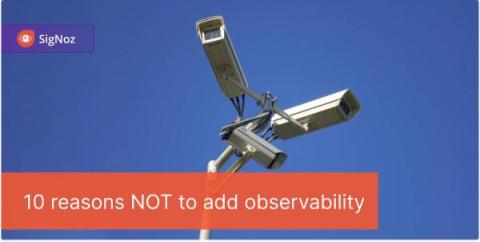
Ten reasons not to add observability
Everyone talks about the need for observability, it even comes up in board meetings. But let’s talk about the reasons you shouldn’t add observability to production.


Every business faces incidents, no matter how tight-knit or high-tech. Downtime, glitches, system failures, and security breaches are all part of online operations. So all companies must prepare to face such issues, including communicating them to key stakeholders. Take widespread data breaches, for example. If a breach occurs, a business might need to communicate with hundreds or thousands of stakeholders, including DevOps teams, affected accounts, investors, corporate leaders, and media outlets.
As the emerging technologies team within ServiceNow digital transformation (DT), we’re always searching for new technology that can solve complex problems. When we saw how generative AI capabilities could deliver rich experiences and unlock the potential of our technology, people, and processes across the organization, we immediately pivoted to embrace it.
The Internet of Medical Things (IoMT) has revolutionized the healthcare industry, connecting medical devices to the internet and allowing for greater patient care. However, with this new technology comes new security threats. Hospitals must be aware of these risks and understand how to find, fix and secure connected medical devices to protect their patients from cyberattacks.
Terraform, a powerful Infrastructure as Code (IAC) tool, has long been the backbone of choice for DevOps professionals and developers seeking to manage their cloud infrastructure efficiently. However, recent shifts in its licensing have sent ripples of concern throughout the tech community. HashiCorp, the company behind Terraform, made a pivotal decision last month to move away from its longstanding open-source licensing, opting instead for the Business Source License (BSL) 1.1.
One of the things we talk about a lot when discussing the current state of the MSP market is the concept of the Red/Blue Ocean. In this analogy the Blue Ocean represents a market where there are lots of opportunities to grow and do more business; while the Red Ocean represents a saturated market where opportunities are harder to find.
At BugSplat, we're always looking for ways to seamlessly integrate critical crash data into the support workflow. Another step in that quest has just been launched - the ability to automatically create defects from BugSplat databases in attached third-party trackers like Jira, Github Issues, Azure DevOps and more. This isn't just a new feature - it's a game-changer. Here's why.
Six months ago I attempted to get OpenTelemetry (OTEL) metrics working in JavaScript, and after a couple of days of getting absolutely no-where, I gave up. But here I am, back for more punishment... but this time I found success! In this article I demonstrate how to instrument a Node.js application for traces using OpenTelemetry and to export the resulting spans to Jaeger. For simplicity, I'm going to export directly to Jaeger (not via the OpenTelemetry Collector).
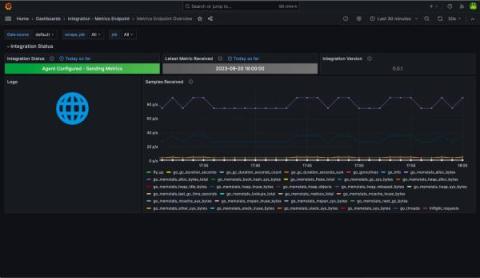
We’re excited to announce the Metrics Endpoint integration, our agentless solution for bringing your Prometheus metrics into Grafana Cloud from any compatible endpoint on the internet. Grafana Cloud solutions provide a seamless observability experience for your infrastructure. Engineers get out-of-the-box dashboards, rules, and alerts they can use to visualize what is important and get notified when things need attention.
The commercial version of InfluxDB 3.0 is a distributed, scalable time series database built for real-time analytic workloads. It supports infinite cardinality, SQL and InfluxQL as native query languages, and manages data efficiently in object storage as Apache Parquet files. It delivers significant gains in ingest efficiency, scalability, data compression, storage costs, and query performance on higher cardinality data.